


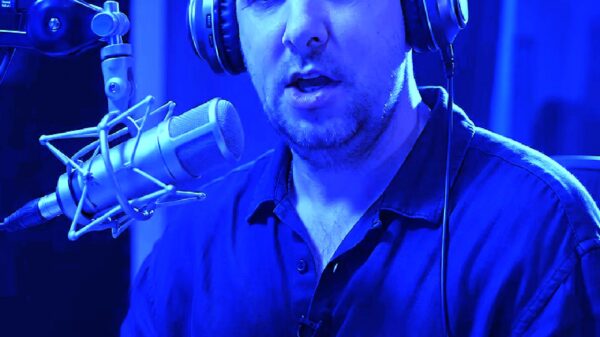






Most days for Ian Noe follow the same routine. He wakes up in his home in Bowling Green, Kentucky, where’s lived for almost a decade, makes coffee, smokes a couple cigarettes, makes another cup of coffee, picks up his guitar and resumes work on the song he was toying around with the night before. He does this basically every morning until noon, at which point Noe might throw on The Breakfast Club or The Birdcage on VHS in the background, or go for a walk in his local park. Either way, he spends the rest of the day so concentrated on whatever song he might be working on that he has no idea what the park he’s walked in for the past decade is even called.
“I don’t know if the word is monotonous,” Noe says, “but as boring as that may sound, that’s kinda what I do. I get up every day and try to get the next thing going.”
Such is life for Ian Noe, the reclusive singer-songwriter whose first two quiet country-folk masterpieces have made him an object of cult adoration among hardcore roots-music fans. After Noe released his superb second album, 2022’s River Fools & Mountain Saints, he toured a bit, but then abruptly canceled a series of shows and largely disappeared from the public.
Now he’s back with Canyon Falls Trailer Band, an astounding 16-song opus that serves as a survey course in Noe’s songwriter prowess. The light premise of the album is that the songs are all performed by a fictional band named the Canyon Falls Trailer Band. Noe refers to the fictional band idea as an “Appalachian Sgt. Pepper”; the concept helped him account for the breadth and seemingly incongruous nature of the material. “They’re all over the place,” Noe says of the band. “They’re writing about Antarctica, they’re writing about prostitution, they’re writing about a jukebox that is alive.”
Noe’s songs are sparse excavations of grief, despair, and weary hope where nary a syllable is wasted and every word is deeply considered. His songs are about old retirees slowly dying of cancer, hapless young men who set their Christmas tree on fire in a fit of heartbreak, and wayward cousins who can’t seem to get on the straight and narrow no matter how hard they try. Many of them are inspired by the real-life men and women Noe grew up around in his home region of eastern Kentucky. But Noe is a much more adventurous — and experimental — writer and record-maker than he’s given credit for. One of his breakthrough tunes, 2019’s “Barbara’s Song,” is the story of the last moments of the lives of people on a crashing passenger train told from the perspective of the locomotive. Other songs of his contain no choruses. His producer, Andrija Tokic, refers to one of the songs on the new album (“Antarctica”) as having “a hue of trip-hop.”
Editor’s picks
Noe is most proud of “Jukebox Blues (For Blaze Foley),” the first-person story of an embodied jukebox who’s sick of playing the same old songs at the honky-tonk in which he lives. The allegory is clear enough: When Noe’s mom first heard the song, she asked if her son wasn’t in fact singing about himself. “To me, I wrote it just about a conscious, literal jukebox. Literally!” Noe says. “But there absolutely is that double meaning. I didn’t mean for it to be that way.”
It’s “Bible County,” however, that may be the most devastating story he’s ever written. Noe says he was almost afraid to share it. “It’s about a lesbian in this place called Bible County, and she had to hide up in a barn, and hide from herself, and she jumps off a bridge,” he says.
It’s a song about the violence and tragedy that results from a small-town prejudice, about the grief and trauma that survivors are forced to live with when hatred and misunderstanding devour a close-knit community from the inside. Bible County is not a real place, but the song is based on real people, on “things I know to have happened,” Noe says. “It’s a different type of story than I’ve ever told.”
Related Content
Canyon Falls Trailer Band is the result of four years of reclusion, tinkering, and obsessive craftsmanship. The album, Noe lets slip nearly one hour into his interview with Rolling Stone, was re-recorded with longtime collaborator Tokic after Noe scrapped an entire other recorded version of this album he made in 2024 (with Nashville collaborators he is too polite to name). He hopes the record is merely the beginning of the world hearing much more from him in the next few years.
“I want to make up for lost time,” says Noe, who spent the week before this album release back in the studio. “You just want to move onto the next thing.”
ONSTAGE, NOE CAN PRESENT as serious if not somber. But in conversation a few weeks before his album’s release, he seems relaxed and relieved, sipping a Diet Coke while Zooming from the kitchen table of his childhood home in Lee County, Kentucky, where he happened to be visiting. Noe was eager to nerd out about songwriting and records, peppering the conversation with praise for everyone from the Ohio indie band Wussy to the country singer Ashley McBryde. He is the type of student of songwriting and record collecting who can recite, from memory, the ratings that critics David Fricke and Robert Christgau gave to Silver & Gold, Neil Young’s semi-obscure folk album from 2000 (Noe thinks Fricke, who gave it 4.5 stars, is “the only one who got that record”).
At one point, Noe gets up from the table and walks into his old bedroom. His mom has gotten rid of most signs of Noe’s adolescence, but he opens the closet and shows me one of the few remaining traces: A pinned-up chart of fundamental guitar chords. “This has been here since I was eight years old,” Noe says. “I spent a lot of my life looking at that chord chart and trying to play Chuck Berry.”
Noe lived in this home from age three onwards. Growing up in Lee County, Noe’s father worked at the local prison and his mother worked at the factory for Lion Apparel, a company that produces protective gear and uniforms for firefighters. At 22, he left home, moved to Louisville, where he laid tile and installed drywall (“the classic things that a musician does”). He eventually returned home, got an office job, then left home again to live with his grandparents and work in the oil fields one county north, where he wrote much of his 2019 debut, Between the Country. Working in those oil fields more than a decade ago was the last job he ever had that wasn’t being a songwriter, he says with pride.
Between the Country, produced by Dave Cobb, was released to a fair bit of excitement. But his more impressive follow-up LP, 2022’s River Fools & Mountain Saints, seemed to be marred by its rollout, or lack thereof. When I start to ask Noe about what happened around the time he began canceling shows and announced he had a broken wrist, he seems eager to offer an explanation, answering before I finish the question.
“Coming out of the pandemic and that whole situation of canceling all those shows, it was a rough time,” he says. “You can write that down on paper and nothing sounds good about it. It was [difficult] for all of us when we were coming out of that era, a weird time. I was briefly here and there in the studio. Certainly wasn’t one of my most productive periods. You just go through shit, go through those phases in life. That’s how it went down, for better or worse.”
What was toughest about that time?
“Probably the isolation,” he says, repeating those three words twice. “I’m blessed and grateful to not be in the oil fields and to be able to get up everyday and have the freedom to write songs, but you gotta step away sometimes. If I don’t watch myself and be careful, I’ll isolate.”
Noe says he can go several days at a time without seeing or speaking to anyone when he’s working on his songwriting at home. “Sometimes I get into my head where I’m listening to music constantly and I’ll forget things. I’ll forget I need to call somebody,” he says. “I can’t just sit here and be gone. But I’ve always kinda been like that.”
Noe takes his songwriting so seriously that he’s already second-guessing lyrical choices on Canyon Falls Trailer Band. “On the title track, I say ‘Sheila’s got the paint cans knocking on the porch,’” he says. “It should have been ‘rocking’ on the porch, because that ‘r’ comes better off the tongue. Is it the end of the world? No. Will anybody else be thinking about that? Probably not. But those single words mean so much to me. It irks me a little bit.”
That obsession translates to the recording process. Unlike most artists, who head to the studio once every few years to cut an album, Noe is regularly making the three-hour drive down to Nashville to record a few songs at Tokic’s studio, the Bomb Shelter.
“He has the most confusing file of anyone I work with,” says Tokic, who adds that there are dozens of songs — both entirely unheard originals and completely different arrangements of songs Noe has released — that they’ve recorded together. “We’ve recut so many songs, so many times.”
One of the reasons Noe chose to re-record Canyon Falls Trailer Band boiled down to not being able to get “Jukebox Blues” exactly right. “I was obsessed with getting the melody with a fiddle,” he says. “It just wasn’t working.”
Trending Stories
And when it comes to touring, it’s no surprise that Noe prefers hiding away in the studio, or at his home writing. “I haven’t been the biggest road dog that ever existed,” he says, a mild understatement. But he understands that playing his songs in front of real people is a key part of having a career, and he says he’ll hit the road in due time. “Toby Keith once said, ‘I could sit here and write all these songs all day long, but what’s it matter if nobody knows them,” Noe says, pondering the quote for a moment.
If he had it his way, he knows how he’d be spending his time. “I’ve always focused on the page, first,” Noe says, “and how good I can make the song.”


