


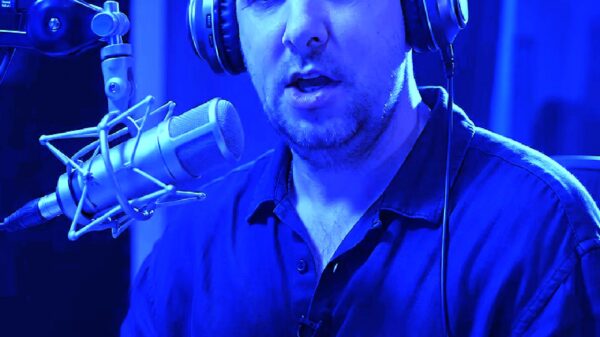






In his newly released memoir, In My Darkest Hour, Megadeth frontman Dave Mustaine details how his 2019 cancer diagnosis changed the way he sees the world. In addition to describing the experience, he opens up about the fears he had throughout and how his family, his faith, and his determination for Megadeth to continue helped keep his focus.
His battle with cancer surrounded the making of Megadeth’s 16th album, The Sick, the Dying … and the Dead!, but pauses in the recording process so he could get treatment were not the only setbacks the album faced. The Covid-19 pandemic made the recording process difficult, and then the band’s bassist, David Ellefson, became the focus of online speculation when footage of him masturbating leaked, prompting Megadeth to fire him and hire another bassist to re-record his parts.
In this exclusive excerpt from In My Darkest Hour, Mustaine reflects on how he and his bandmates got through the difficult time with additional commentary from drummer Dirk Verbeuren beginning with the realization that Covid was cutting off any opportunity for performing live.
With touring not an option and a gigantic revenue stream effectively wiped out, it became imperative that we focus all efforts on producing a new album. This wasn’t just about me — as noted previously, there are a lot of people who rely financially on Megadeth. And, of course, we wanted to give the fans something to chew on while they waited for the next tour — whenever that might be.
And so we went about the business of work, taking every possible precaution while trying to keep everyone involved in the making of the record safe and healthy. We all wore masks. We all washed up. We maintained a meticulously clean environment. I had the housekeeper from my home come over and clean the farmhouse and studio house continuously. We only ate organic food. We limited our circle of trust (so to speak), creating a bubble that included only people whose contributions to the album were critical. There were no visitors, no strangers from the outside. I guess you could say that we did what everyone else did during COVID: we worked diligently and got the job done despite some serious challenges.
We were really careful, and in some ways probably more focused than ever, because the stakes were so high. We didn’t want anyone to get sick or feel that they were putting themselves at risk. The label wanted a new album; fans wanted a new album. Life went on.
From Dirk Verbeuren:
My part for the record was done during COVID, so actually I believe it was in May of 2020. I drove from Los Angeles to Nashville because it was during the pandemic and we didn’t know whether it was safe to fly. Dave had just gone through cancer treatment, so of course I didn’t want to take any chances at that point by getting exposed.
We didn’t know much about it at all, so I was, like, I’m just going to rent a car and drive. So I did the whole thing pretty fast — three, three and a half days — driving from Los Angeles to Nashville, and then recording the drums for the record. At that point, it was mostly the other guys working on the record. I would have probably gone there more and spent more time in the studio with them, which I’m hoping to do this time around, but back then it was, you know, stay away from each other as much as possible. It’s kind of the opposite of what we like to do. I mean, I’ll send stuff to [producer] Chris (Rakestraw) for demo purposes, but when it comes to recording the actual final thing, we do the real deal, where Dave and Chris are there, because they’re producing the record together, and they’re present when I record my final parts.
For the last record, a lot of it was done separately, at Dave’s studio, because that’s just the way it worked out with COVID. But I know that in the past they’ve done records where they played all four together. I know they did that for sure for Youthanasia, and I’m assuming some of the other early records as well. And I personally kind of tried to see if that would be something we could do again, because I think that would be really cool. But I don’t know. It obviously requires for the songs to be in pretty final shape, and then for everybody to know them really well, and to play together, so it’s a more time-consuming process.
And with everything we have going on, and how busy life is these days, we might end up doing it separately again. Who knows. It’s rare nowadays also because technology is so good, and a lot of bands live spread out, versus in the same town. But it’s great to be together as much as possible.
By the spring of 2021, it appeared that we had weathered the storm. The majority of the new album, tentatively titled The Sick, the Dying . . . and the Dead, had been completed. We were still tweaking, making some adjustments, getting ready to ramp up the promotion and marketing schedule. Meanwhile the world was beginning to emerge from the fog of COVID.
Vaccines were available, restrictions around social gatherings were loosening. People were getting on with their lives for the first time in more than a year. We were all excited about giving fans their first Megadeth record in five years! And then going out on the road in support of that album at some point later in the year.
We had survived my battle with cancer. We had survived the pandemic.
I knew that we had a good album nearly in the can. I could feel it my marrow. What could possibly go wrong now?
I found out about the scandal the same way that everyone else found out: I heard about it online. On May 10, 2021, sexually explicit videos of David Ellefson masturbating appeared on Twitter. The videos resulted from an online interaction with a nineteen-year-old Megadeth fan with whom Ellefson had engaged in some sort of relationship. When more details were revealed, the story quickly went viral.
It was impossible to separate fact from fiction, truth from fantasy, as the internet exploded in typically histrionic fashion. But this much was clear: that was definitely David Ellefson, Megadeth bass player, in the videos.
The next day, we released an official statement saying, “The situation is being watched closely.”
That was true. It was also true that I was reevaluating my nearly 40-year relationship with David and the turbulence it had so often caused in my life. As original members of Megadeth (David likes to say he was a “founding” member. I don’t view it that way. I started Megadeth and invited him to join), we had been friends and creative partners; we had fought like enemies. We had played a lot of great music together. We were codependent junkies, feeding and fueling each other’s addictions. Ultimately, we had grown apart, trust shattered (at least for me) by David’s 2004 lawsuit after the band’s breakup. We fought in court. The outcome was not nearly what he hoped for — let’s leave it at that.
To the surprise of the vast majority of the Megadeth universe, we patched things up in 2010 and David returned to the band, albeit as a salaried player and not a creative partner. But things were never great between us; there was too much history, too much anger, too much behavior that I found distasteful.
Part of the problem was that our initial friendship was based primarily on two things: music and drugs. David and I were never on equal footing when it came to Megadeth; it was my band and mostly my songs, and that was always a source of friction. When we both got sober, the distance increased, in part because we had lost the awful, unhealthy thing that had bonded us, but also because we approached sobriety and recovery from different places, with different points of view. I tried not only to be substance-free, but also to live a more honest and spiritual life. There are plenty of people in the fellowships who want to be better human beings and to provide support for their fellow travelers, people who are committed to genuine transformation. And there are others who mostly just talk the talk.
I try to stay away from these folks. Sometimes unsuccessfully. All of this is by way of saying that by the time those embarrassing videos turned up on the internet, my relationship with David — and David’s relationship with Megadeth — had already begun to deteriorate.
Again.
Some of it was probably borne of professional jealousy — long a friction point between David and me — and some of it was probably frustration stemming from financial pressure. I’m speculating, of course, and I’ve never asked David about this — we haven’t talked in several years — but I heard that David was upset that we canceled the tour when I was first diagnosed with cancer. And he was sometimes short-tempered and impatient with me when I was going through treatment and trying to work on the album. Some days I had a lot to offer in those sessions; sometimes I was too tired and sick to contribute much of anything. While everyone else seemed to be compassionate and understanding, David sometimes was not.
Hey, on some level I get it. My illness cost everyone involved with Megadeth a lot of money. It was a scary, uncertain time. But it’s during the darkest times that a person’s character is revealed.
Would David have remained a member of Megadeth if that video had not surfaced? Who’s to say? I’ve seen enough guys come and go with Megadeth, and I’ve experienced enough upheaval with David to know that the end was likely near. But, certainly, the scandal hastened the process.
Within a few days, we informed David that he would be separating from the band. Then, on May 24, I released an official statement through the band’s Facebook account. I tried to keep it as simple and straightforward as possible, as enough damage already had been done:
We are informing our fans that David Ellefson is no longer playing with Megadeth and that we are officially parting ways with him. We do not take this decision lightly. While we do not know every detail of what occurred, with an already strained relationship, what has already been revealed now is enough to make working together impossible moving forward. We look forward to seeing our fans on the road this summer, and we cannot wait to share our brand new music with the world. It is almost complete.
The last part of that statement was both true . . . and not true. Yes, the new album was basically finished. But Ellefson’s dismissal complicated matters. As Megadeth’s bass player, David was all over the new album, and his participation would almost surely become a distraction, if not worse, when the album was released. There would be financial entanglements as well. In the end, we made a decision: David’s bass parts would be scrubbed completely from the album and re-recorded with a new musician.
If this sounds tedious and time-consuming, well . . . it was definitely the former, but not really the latter, thanks to the fact that we found absolutely the right guy for the job: Testament bassist Steve DiGiorgio. I’m not sure anyone else could have done what Steve did, given the same set of circumstances. For one thing, he’s totally metal. He’s also an absolutely ferocious bass player, as well as a sweetheart of a guy. And I’m not sure that anyone who didn’t possess those traits, in more or less equal measure, could have survived this gig. We asked Steve to come in and learn more than a dozen tracks that he had never heard before, and to do it virtually overnight, while taking over for someone whose departure had been quickened by scandal.
It was one hell of an assignment.
Actually, it wasn’t an assignment at all. Chris and I put together a list of candidates, then I reviewed their files to determine which of them seemed to be a good fit for what Megadeth was trying to do on this album. And Steve was the clear winner. I reached out — told him we had a fire to put out and needed his help. But I made it clear up front that this was a short-term gig. No touring, no permanent spot in the Megadeth lineup. I didn’t want anyone to think that I was trying to poach him from Testament. While I didn’t know Steve personally, I was friends with other people in the band, and I would never do anything to hurt those guys. The whole arrangement was completely transparent.
Fortunately, Steve had a small gap in his schedule and agreed to take on the gig. Astoundingly, he learned and re-recorded all the bass tracks in roughly two weeks.
Two weeks with a lot of long days, but nevertheless . . . two weeks.
Fucking amazing.
Excerpted from IN MY DARKEST HOUR: A Memoir by Dave Mustaine with Joe Layden. Copyright © 2026 by Dave Mustaine. Available from Da Capo, an imprint of Grand Central Publishing, a division of Hachette Book Group, Inc.



