


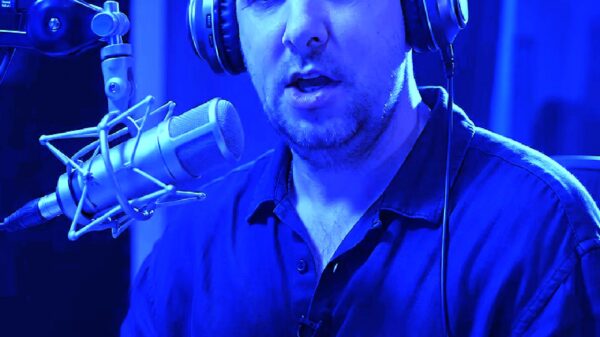






One of America’s most beloved and long-running competition shows, Dancing With the Stars, begins its 35th season on Sept. 15 and 16 on ABC and Disney +. Though every season brings a new slate of stars — including Ciara Miller, Julia Stiles, Amber Glenn and Jenna Dewan for this fall’s cast — Dancing With the Stars has had one constant over the last 17 seasons: music director Ray Chew.
Explore
See latest videos, charts and news
Chew, leading a 14 piece band, has played an instrumental role in modernizing the music of the show, taking it from a classic ballroom feel to one that reacts in real time to pop culture trends. He’s led his crew of musicians through a recreation of hit Broadway musical Wicked, a night of TikTok viral hits and just about every genre, tempo and style.
To pull it off is no easy feat. DWTS is shot in real time, and the music director tells Billboard his average show day begins at 3:30 AM, and doesn’t end until the show wraps that evening. Throughout the week, his team is also racing against the clock to create arrangements for songs the choreographers are picking in real time, a process he lovingly refers to as “unbaking the cake,” or trying to sleuth out each element of the song so that his musicians can rework it in a matter of days.
Meanwhile, the show’s music supervisor, Nancy Severinsen, is working to clear the rights for the songs, which, as Chew explains, doesn’t always work. “To clear one song, it could have two writers, [or] it could even have seven publishers,” Chew explains. “You got to contact everybody, and everybody’s not waiting around on their phone to be contacted. Some of the music clearance happen right up until the last minute.” He notes that even on the Wicked night they have to rework their original plans to satisfy the vision of the original rights holders of the music.
Still, Chew takes it all stride — he knows how to work under the pressure of live TV. He got his start in the band for Saturday Night Live back in the 1980s, and then has gone on to music direct everything from the Grammy Awards, Macy’s Thanksgiving Day Parade, Miss Universe, the Emmys, the BET Awards, American Idol, Showtime at the Apollo and more. Dancing With the Stars, however, he says is like a “unicorn” for live TV.
As using live musicians becomes increasingly less common, the dance competition is a bright spot, which one of the largest, if not the largest, live bands on screen today. “It’s a blessing,” Chew says. “It’s a blessing.”
To discuss how the show comes together every week, and the important, but little understood, role that music directors hold, Chew joined Billboard’s music industry podcast On the Record.
Watch the episode on YouTube, or read an condensed and edited version of the conversation below.
Billboard: Can you walk me through the timeline of a week on Dancing With the Stars?
Ray Chew: Our show day is Tuesday. Wednesday is when we get our assignments. Now, it would be great if we could get in front of this a lot more, but we can’t because it’s a contest. We don’t know who may or may not be on the show. So, yes, they may know what they want to do, but we may not know that they’re going to do it. So Wednesday, I get the assignment. I take a song, a very popular song, and I have to deconstruct it. The process I actually call “unbake the cake.” I have to figure out what’s in that sauce, what’s in that gravy, what makes that really move and tick. Why do people love it? What’s that signature sound that you can’t be without? Nobody’s handing us these ingredients. We have to go in and figure out what’s in that song. Is there a special sound in there? A special synthesizer? What’s happening? And in particular, the vocal. So for the vocalist, we have to do what we call vocal shaping. All right, so if we have a song that is very popular, you don’t want to be out of character. You’ve got to meet the character. Sometimes it’s in all the nuance.
So my prep week starts on Wednesday. We get the song list on Wednesday. At the same time, we have to deconstruct the song. So, 16 songs, right? You have to go through them one by one. That takes hours and hours of work, just trying to take one song and figure out what’s going on in there. Now we have to start doing arrangements for those songs, and that takes days. So we have Wednesday, Thursday and Friday to prepare everything we need to do, and then Saturday we have a full-band rehearsal.
On Saturday we have our band—the singers, musicians, everybody—assembled in the ballroom. We have to go through all the songs and make sure that everything is correct. We also have to make sure our audio team hears all the things, because a Frank Sinatra song is not going to sound the same as a Katy Perry song.
How have you seen the show evolve since you got started with it?
Well, the audience has certainly gotten a lot younger and a lot more engaged. I think when I started with the show, it had already been running for 10 years, so it had a very established audience, and it was really a ballroom-type sound with a very traditional presentation. When I came in, I think it was at a turning point where they really wanted to contemporize this stuff. We had to say, “Hey, man, we’ve got to talk to a younger audience. We’ve got to do some songs that are younger and bouncier and have a different thing.” And we’ve evolved into that completely now.
You guys are now also airing Dancing With the Stars on streaming services. Does that impact how the run of show goes on the day of?
Not for us. But two seasons ago — or three seasons ago, during the pandemic — we had to reconfigure everything just to get the show presented at all, because everybody had to be in different quadrants. We couldn’t be in the same space. It was a lot, even just trying to get the show going. That’s when they started doing the streaming. Now that we have a dual package to present, the streaming doesn’t necessarily impact what we do. We do what we do, and then they stream it.
On the day of the performance, what is that timeline like for you?
Well, it starts with the night before. I have to go to bed at 9 o’clock, which is totally against my whole body. But it’s because I have to get up at 3:30. Then we have to be on set at 5 or 5:30 sometimes, I have to allow time because you never know. You’re expecting no traffic at 4 in the morning, but you never know. We have our entire music team, which is 14 musicians and singers, and we’re expected to be on. When I say “on,” I mean it has to sound as live and as great as it can. You can’t say, “well, we’re waking up and we know we’re going to get it going.” No, you get it going. You’re going at 5:30.
We start at 5:30. We do a rehearsal of some of the revisions they may have wanted. They’ll tell us, “Hey, I need a little of this over the weekend,” so we have notes, and we’ll start with that. Then the dance teams come in at 7. We’ll do a camera block with them until about 12, and then at 12 we take a lunch break. We do a dress rehearsal from 1 to 4:30, and then we go on air live at 5:30.
It seems like a luxury in TV today to get to work with 14 musicians — live musicians — week after week. I could imagine some productions just wanting to cut costs and be like, “well, a master recording is good enough. We’ll just license that.” Have you seen TV shows change over time in their willingness to hire live musicians?
This is the dinosaur. Well, I don’t want to say dinosaur — It’s a unicorn. We’re a unicorn because I don’t see any other show that do this. Some of the other shows continue to have live music, but it’s not 14 musicians. All credit goes to the fact that there’s an appetite for this sound. The audience is loving it. When I went to the Dancing With the Stars convention, the fans were coming up to me. I was like, “wow, this is beautiful.”
The comment I got most was, “We love what you do,” because anybody can play a master recording. We hear that all the time. We’re bringing a different life to the song.
Have you ever had a musician who you’ve covered on the show reach out to you and say thanks, or that they loved the cover you performed on the show?
Yeah, I’ve had that a lot. We did Janet Jackson week, and Janet Jackson also made a video appearance, but the producers of that project are Jimmy Jam and Terry Lewis. They’re very special. I know these guys, and I was like, I am not going to not make — by the way, I give the same attention to everything, but I was like, “you know what? I know these guys are watching, so let me make sure every little thing that I can think of is as good as possible.” The good news is that they contacted me afterward. Jimmy Jam said, “Hey man, you did us right on that stuff.”



