


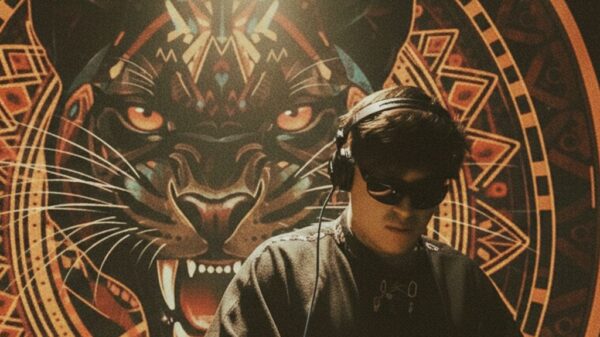






The best way to describe my For You Page is as a Disney Channel series with a rotating cast of characters who seem to materialize out of nowhere and then, a few hundred scrolls later, begin to feel like lifelong companions. There’s Kai Cenat, currently on hiatus from Twitch, of course. But there’s also the broader streaming universe: the Clover boys — Rakai, Madi2Hotty, Reem, and their orbit — or the now-scattered FaZe creator crew, including names like Plaqueboymax, Lacy, and JasonTheWeen. Then there are the special guest characters: the endlessly charming Yonna, or Drake’s bestie Bendadonn, whose clips occupy my feed so thoroughly that I could probably hold my own in conversation with the most brain-rotted teenager you put in front of me. Which is why, for the past week, I’ve been unable to stop squealing, “I think I’m Clover now,” a line from “Over,” the new single by streamer Raud Geez, who releases music as GE3Z.
Over the brooding, stuttering drums associated with Philly’s current rap vanguard — think the menacing beat behind Skrilla’s “Doot Doot” — Raud raps in an infectious cadence, high-pitched but never treacly, almost like Lil Tecca if he were dropped into Philly’s rap scene. Lyrically, the song is built around a handful of snappy couplets: “I had a bitch a little bit / that shit over now,” he raps. “I been with Reggie for 30 days, I think I’m Clover now.” That last line is a nod for the brain-rotted among us. Reggie is part of the Clover Boys universe, the streamer-house ecosystem orbiting Kai Cenat, AMP, and their extended world of collaborators, rivals, and content-fueled beefs. It was that line that caught the ire of what I’d describe as the villains of the streaming world: Kick creators like Adin Ross and Cuffem, figures from a parallel shock-content economy where slurs, far-right guests, and racist provocation make up their everyday content.
I actually have these villains to thank for hearing the song in the first place. Clips of Cuffem trashing “Over” — for what it’s worth, Cuffem seems to hold standing grievances with Kai, AMP, and basically anyone on the wrong side of the Adin Ross cinematic universe — started spreading across my feed. Except there was nothing anyone could do to make me hate what I was hearing. Eventually, the comments started to turn, too. A few days after Cuffem’s hate clips began circulating, other creators were rapping the song on stream, unable to deny its catchiness. Bendadonn and DDG have an entire segment where they riff on the song’s cadence, stretching it into the kind of joke that only works when everyone secretly loves the source material.
Editor’s picks
DDG, for one, understands how fraught the transition from content creator to musician can be, and over the weekend, he brought Raud out during the New York stop of his Blame the Chat tour to perform the song. Haters be damned, the crowd knew the words. After the set, Raud threw a little more lighter fluid on the feud, telling Cuffem to “eat a dick.”
Trending Stories
Drama aside, “Over” is more evidence of livestreaming’s growing gravitational pull on hip-hop. For years, going from online personality to rapper mostly meant fighting the suspicion that you were a novelty act, a meme, or both. But the current streamer ecosystem is no longer just adjacent to rap’s attention economy; it is increasingly part of the machinery that moves it. Names like Plaqueboymax have real pull in the underground, while artists as big as Drake now treat creator platforms and livestreams like natural stops in a rollout. Part radio station, part rap blog, part teenage lunch table, part WWE storyline, the streamer economy has its own logic for making records travel: a song can break because someone loves it, because someone hates it, because a rival streamer misreads one line, or because the hook becomes useful enough for everyone else to repeat.
That’s what makes “Over” feel more interesting than its own modest ambitions. It’s more than a catchy song by a streamer; it’s a catchy song that understands the world it occupies. Raud doesn’t have to escape the content economy to become a musician. He can make the whole machine work for the record: the beef, the clips, the jokes, the alliances, the haters, the fans — all of it whipping around the hook until the song feels less like a novelty than a fact. In other words, it’s a hit.