




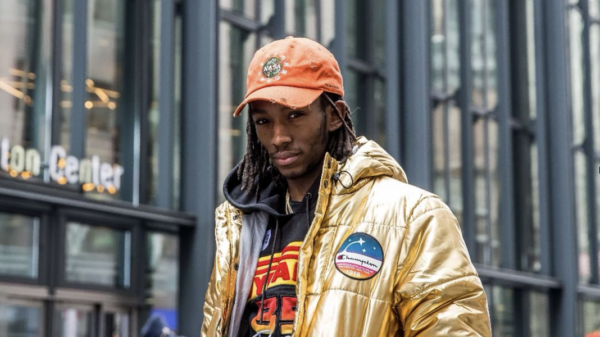



To tell the story of Fab 5 Freddy — the ceaseless creative polymath, train-tagging graffiti misfit, renowned gallery artist, sample-inspiring rapper, charismatic TV host, global ambassador, restless bon vivant, socially conscious director, and connector of ostensibly disparate scenes — is to tell the story of hip-hop itself.
As a deeply curious kid in Brooklyn’s Bedford-Stuyvesant, Fred Brathwaite kept his ear to the door of his dad’s basement, listening to his father and his friends (who included Brathwaite’s godfather, jazz drummer Max Roach) discuss art, music, tech, politics, and culture. He’d devour art and architecture books, hit every art museum in the city, and listen to radio DJs like Frankie Crocker eschew genre in favor of whatever sounded good.
Inspired by the pop art movement popularized by artists like Andy Warhol and Roy Lichtenstein, Brathwaite became one of New York’s most celebrated graffiti artists in the 1970s, tagging whole train cars and adopting his moniker after graffiti crew the Fabulous 5ive.
As he writes in his new memoir, Everybody’s Fly, “The Pop artists had drawn from the same visual language we did: comic books, advertising, big colorful product logos … Maybe New York City itself could be an art gallery. A museum of my own.” Alongside friends and fellow street artists Jean-Michel Basquiat, Keith Haring, Futura 2000, and Lee Quinones, he brought street art from the trainyard to the gallery, eventually becoming an internationally recognized visual artist.
But that’s only half the story. Few cultural figures did more to shape hip-hop in its formative years. Serving as the crucial link between early hip-hop pioneers, punk and New Wave musicians, and the downtown art world, Freddy always seemed to be wherever the culture was. A name check on Blondie’s 1980 global hit “Rapture” and appearance in the video helped introduce both hip-hop and Freddy to a wider audience, as did 1983’s Wild Style, the first and still the best movie about hip-hop that Freddy produced, starred in, and composed the music for. (A career-changing 1991 New Yorker profile by Susan Orlean called him, correctly, “the coolest person in New York.”)
“For whatever reason, I have always had an instinctive connection with creative people and scenes,” he writes. “I’ve been lucky to find community …. wherever I go and bring out creativity in others while drawing it out of myself … I’d created my own playbook, followed my own path, and made a life rooted in creativity and connection.”
For seven years, starting in 1988, a new generation knew him as the charismatic host of Yo! MTV Raps, introducing hip-hop to millions around the globe and becoming, to this day, one of the genre’s most tireless ambassadors.
As he continues his artistic career — he’s currently working on pieces connected to the history of Black pirates — he’s also entered the cannabis space with his own company, B Noble Global, named after Bernard Noble, a Black man who served seven years of hard labor for possessing a minute amount of weed.
As he regales Rolling Stone from his Harlem apartment with story after story of a bygone New York that’s practically unrecognizable now, Fab 5 Freddy isn’t used to looking back. But more than a personal memoir, Everybody’s Fly could comfortably sit alongside books by Richard Price, Lucy Sante, Tom Wolfe, or Ed McBain, chronicling New York from the mid-1970s to the early 1990s with both vivid, journalistic descriptions and the outsized flair from a person who was at the center of it all.
What was your initial goal when you first started writing the book and how did that change?
One of the big things for me was there was a lot of stuff that I’d had my hands in heavily, that I would feel like I’m bragging. I really just wanted to lay out things that I played a role in that were not as succinctly told. With hip-hop becoming so big beyond expectations, “Hey, I’m the guy that did this and I’m the guy that did that.” I’d be like, “You know what? I’m going to wait until I get a chance to lay out my entire story so people can see, ‘Here’s where I come from. Here’s what inspired me as a kid. Here’s how I got to this point where I’ve been able to connect with key players on the New York downtown cultural scene that clicked with my ideas and we were able to get shit moving and grooving.’”
You write, in reference to Basquiat, “Jean, like me, was always focused on the narrative. He wanted to control his story the way I wanted to control mine.” Was that part of the reason for writing this?
Yeah, because that was something that got to me. Being around my dad and his super hip, super knowledgeable friends – especially my godfather, Max Roach – I’d hear snippets of conversations as I grew up about how frustrated they were with what they couldn’t do in those times; as young Black men who wanted to have more control, wanted to have labels, wanted to control the narrative, write those pieces in the major publications. It wasn’t possible.
Understanding as I’ve grown older the influence my dad and his friends had on me before I was conscious of the fact that that motivated a lot of moves I would make. Some of their frustrations – things that they were not able to do in their era – were what drove my decisions: how to put myself in a space to make these things happen; how to be an artist; how to bring other people in. That meant a lot to me.
I got a sense of that frustration and I was like, well, I want to make sure that that doesn’t happen when I tried to shape what the narrative [of my career] is. “Here’s my intention. Here’s where my drive was.” That came to fruition in ways that I’d planned and some that I didn’t.

Jean-Michel Basquiat, Andy Warhol, and Fab 5 Freddy in 1984.
Patrick McMullan/Getty Images
You don’t shy away from the deaths of Basquiat and Keith Haring. But unlike many memoirs where hardship is the emotional center, yours feels much more celebratory in general. Was that a conscious choice or natural byproduct of the life you were living?
[Pauses] I’m a half-full guy as opposed to half-empty. So I’m constantly looking for that [and] I’m going to find that. That’s how I got to this point, is not dwelling on how fucked up shit has been and sometimes still is. I’m trying to make that lemonade out of those lemons that you didn’t expect to have all over yourself. So that’s kind of a sense of how I get down and how I was able to make things happen. The kind of hand that a lot of folks are dealt is not the best hand, so how you going to work around that is how I came up.
But, look, a lot of shit happened that was incredible stuff beyond expectations. We wanted to make a movie [Wild Style] that would rock the hardcore homies from the hood that went to see movies on 42nd Street proper when it was grimey as fuck. And we wanted to rock our downtown arty friends.
There’s also moments of seeing what your life could’ve been like had it gone another way.
Yeah, there was a men’s shelter on 3rd Street and there were homeless guys on the corner. You see these guys all over the East Village, and at times I’d see guys that I know, young Black guys that couldn’t have been too much older than me. And I’d be like, “How did this happen? That could be me.” One time, there was a homeless person on the train and I was like, “Oh shit, I recognize that guy.” I went up to him and started to talk to him. And I remember bringing it up to Jean-Michel, man. It was a quiet moment where we looked at each other like, “Yo.” One of the notes from my editor was like, “Man, can you give us some more of what challenged you like that?”
You talk about the myriad movements that inspired your art, including dada, pop art, and futurism. But you also write that a lot of graffiti “came out of the spirit of rebellion and protest that we’d grown up around as little kids in the sixties.” What effect did that counterculture ethos have on you and your art?
As a kid, you’d see campus protests on the news. My dad was at King’s March on Washington. He was in the room when Malcolm X was assassinated. Looking at white kids growing their hair long – which was shocking to people – and all of that stuff led to kids all over the city just feeling comfortable writing their names all over everything.
That was sort of the sense of challenging the establishment. We’d see Aron Kay, a Yippie [who was this] big, fat white guy with a thick moustache that would throw pies in celebrities’ faces. The Yippies were super cool. In the crew that I ran with – Jean-Michel, Keith – we were all aware of the fun that the Sixties artists had, like Andy [Warhol] and them partying, being around cool bands like the Velvet Underground. Jimi Hendrix walked down this block in the East Village.
You’d still see Alan Ginsberg walking around. It was like, “Yo, that’s fun, man, and they’re making good art.” All that was just like, “Oh my God, this is how it should be.” So we wanted a semblance of that and were trying to recreate some of that energy; it inspired a lot of what our scene was about.
Fab 5 Freddy atop one of his creations in New York City, 1980
Charlie Ahearn
So much of your career, especially early on, has been about pushing into these spaces that were traditionally closed off due to race, age, or artistic snobbery. At the time, did you look at this as a form of rebellion or is that something that only makes sense in hindsight?
Yeah, it was like, how do we get in? I’m not coming from a traditional place where artists were coming from, so how do we crack this nut? And so part of my strategy was making alliances with people on that New Wave scene who just seemed so wild and crazy. You’d read articles in a fanzine from some wild bands. These guys like, “I don’t even know how to play my instrument and shit.” And it was so fucking shocking to established rock and roll people or culture gatekeepers. I said, “Yo, this shit sounds crazy.” I had a gut feeling that if I connect with the right people, I could have a discussion about this stuff that I’m bringing to the table – having an equal, rebellious kind of core. The forms were different, but the way we were going up against the system [was the same].
To really achieve as graffiti artists, you had to be stealthy. Not getting caught was a key mandate. So along with getting your name everywhere, not getting popped was a key thing you also had to maintain if you were really nice with it. And I thought I want to keep that same ethos as I moved my way into pop culture spaces that are not expecting me to show up. With graf, it was, “We’re going to figure out a way to make this shit happen” and that was the same thing that I would tell myself to keep myself pumped up [in other creative pursuits].
What was the most rewarding part about being an outcast?
It was all so new and so different. But what was really comforting was being in a space around a lot of extreme creatives that were primarily white, but we were all a family. They were as outcast as I would be in a certain situation. And they’d chosen to leave the suburbs or whatever the environment. I remember Jean-Michel and I at one point realizing, “Dude, we’re like two of the only people from New York in the mix doing our thing.” Everybody else is, “I’m from here,” “I’m from there.” And they came to New York to figure it out.
There’s a great scene in the book talking about the graf artist Zoro, one of the main characters in Wild Style, who had to “stay an anonymous outlaw or team up with fancy uptown collectors.” Walk me through your frame of mind at the time, as you were dealing with that dichotomy yourself.
I was more specifically ready to make the move [from street art to established galleries] because I had been looking at what the art world was about. I had read a bunch of books on pop artists and the abstract expressionists and was beginning to figure out how the machine works somewhat from, once again, not having gone to art school or knowing anybody in those spaces. And being into Andy Warhol and understanding how he was able to manage a very high-profile presence, yet when you deal with the business of art, you’re going to have to be able to manage and deal with collectors.
“The Return of God to Africa” and “Still Life in Space,” by Fab 5 Freddy, 1984.
Fred Brathwaite, 2
You mean the collectors who care about the art versus the ones that are purely motivated financially?
Yeah, hopefully you deal with the good, real collectors that really have a passion and love for art, as opposed to those that are more speculative and just want to make money off your work or get something that matches their living room furniture. I would talk with Keith Haring about this a lot [because he] was very concerned with making sure that a portion of his work was affordable and accessible for the real people, as opposed to if he hits, the prices that will immediately come to his work.
So Keith’s idea was to open the Pop Shop [a store Haring founded in 1986] and sell these little affordable pieces of his work as opposed to the few thousands or whatever he was getting for the actual paintings at that time. Figuring out how to balance that out and navigate on our own terms was something that we talked about and were very aware of.
Keith spoke to Rolling Stone in 1989, about six months before his death, and said, “As soon as you get some acclaim, you have alienated some people that think that they deserved it instead of you, so you sold out. I never sold out.” You write in the book that you told an interviewer in 1984 that “selling out is my objective. We’ve been given the opportunity to preserve our work and get paid for it.” Does Keith’s quote resonate with your own personal approach to your art?
That’s a perfect snapshot of conversations we would have, and that’s Keith right there. He was very concerned and conscious about that. I can relate. That’s high-level art world thinking, and that was what was unique and so great about connecting with Keith, Jean, Kenny Scharf, a bunch of the artists that were my immediate contemporaries, because we were thinking about these things and trying to figure it out. But these were things that when you’re conscious of the business and how the machine of the art world can take over, the best scenario is you battle that and get those things on your own terms.
On the other side, though, you write a lot about luck: “Call it luck, kismet, whatever: If I kept myself tuned into the right frequency, open, curious, receptive, I might actually catch some.” Do you worry that understates how intentional you were with your various avenues of creativity?
I don’t think I had it framed up like that at the time. But after a lot of events happened in my life, at a point I was becoming maybe insecure or unsure or “Is this imposter syndrome?” When Yo! MTV Raps happened, people came up to me and wanted to know, “Hey man, how did that happen? I’d like to audition for that. Where do you go?” And I would be like, “Holy shit, I just got asked out of the blue, so to speak.” So it made me feel kind of unsure and unstable about certain things.
Then it hit me. Wait a minute, I put myself in a place where these things could happen. So I started off on a journey to get to a certain spot. And in retrospect, trying to understand how these things would happen like, “Dude, I can’t answer how I got to be the host of this show or how this fuckin’ happened.” And then you realize, “Wait, I started out on a journey, and along this journey, this happened. I met this guy. I met that guy.” And one person said, “Hey, Fab, you ever think of doing this?” I’m like, “Well, no, but I’ll give it some thought.” And that made more sense to me than it just being this random thing.
Well, you do also write, “It was inevitable I’d be well known someday, based on the quality of work I plan to do.”
[Laughs] I told Debbie Harry that, yeah. Yeah, I was confident. [Laughs]
The book isn’t just your journey — it doubles as a love letter and a eulogy to an intensely fertile and creative period in New York. How much was about tapping into your raconteur side to preserve this era and the people that shaped it?
Both things were the intention. I wanted to take you there and really tell my stories. I’m amazed that people are still so fascinated by it and about what happened. And I’m like, “Shit, when I tell my story, I’m going to lay all into that and give you some of that.” Because it was transitioning.
Clearly the culmination, if you will, was seeing the Tompkins Square Park riot go down. [In 1988, the police charged a group of protestors in New York’s East Village and started a riot that led to over 100 complaints of police brutality.] I constantly reference how the extreme activists at that time would be talking about these corporations that wanted to come in and buy up and do big things in the neighborhood. And I’d always be like, “You guys are exaggerating.” But I lived at 170 Ludlow Street [in New York’s Lower East Side] and there’s two high-rises on that block now that were built amidst those tenements. It’s like, “Holy shit, those guys really fucking knew what this could turn into.”
At Yoyogi Park in Tokyo with Busy Bee and the “Wild Style“ crew, 1983
Charlie Ahearn
Not long after that, you channeled your Wild Style character Phade to “create,” in a sense, an exaggerated version of yourself for Yo! MTV Raps. Where does Fab 5 Freddy stop and Fred Brathwaite begin?
Well, you’re talking to Fred Brathwaite now, not Fab 5 Freddy. This is not the kind of intellectual type of way I would want to come on a show. One of the first people that hit me with it was Ice-T during an early trip to L.A. in the 1980s at my first big show at the Ace Gallery. I’m hanging out with him kicking it street; the way I talk with street folks or whatever, whatever. And boom. A collector came into the gallery and literally in the midst of talking to Ice-T, I spin and I’m in more of an intellectual conversational mode, nothing big to me. And then I turn back and I’m kicking it with Ice-T on some street shit.
Ice-T was like, “Dude …” He was blown away. He’s like, “Man, do you realize what you just did?” I’m like, “What are you talking about?” I equate it to people that speak other languages; it’s communication. It wasn’t like I’m trying to affect some fake version of myself. I could articulate in an intellectual way in standardized English, and then I could kick that street shit. And it just flows.
Wild Style is rightly considered the best movie about hip-hop. What comes in second?
Of the Wild Style copycats, Beat Street made a great effort, because they got the real deal people to be in the film. Some of the story is kind of wanky, kind of corny, if you will. Wild Style was no Gone With the Wind, script-wise, but our intent was to feature the real deal people and have them play themselves. Krush Groove was decent in terms of getting the right artists to do their thing in a way that was effective and believable. [For completists, the worst ones, Freddy writes, are Breakin’, Breakin’ 2: Electric Boogaloo, and Rappin’, in which Mario Van Peebles plays John “Rappin’” Hood, an ex-con who uses rap to fight gangs and unite his community against gentrifying developers.]
In 1991, you told the New Yorker that in college, “I wanted to be a famous artist” and that “what I have now as far as fame is excellent. I’m known, but I’m not too known. I can still walk around. I can still eat dinner out. It’s not too much, not yet.” Are you as famous as you were hoping to be?
This is more than 30-plus years later. I think I’m satisfied. This shit can get really awkward. There was a point during Yo! MTV Raps where hip-hop fans really tuned in and were pretty much attuned to the culture and saw me in that context. Then I did a Colt 45 commercial with Billy Dee Williams – Lando Calrissian in Star Wars and all that shit. They wanted to spice up that campaign and bring in a younger energy.
Dude, I’m not a guy that would move around with bodyguards or have a whole entourage. That’s a special New York thing. People don’t trip. But when that commercial was running, I had a few moments where people were like, “Oh my God, are you him?” It was just like, “What the fuck?” You couldn’t even engage with these people. So I had a snippet of the craziness that could come with a more heightened type of celebrity, which could make life really uncomfortable. LL Cool J once asked me, “Fab, please, let’s go to a museum. I want you to just show me some stuff, but I’ll put on a disguise so we can move around.” And then that hit me, like, “Oh, shit.”
How important for you now is legacy-building or recognition in general?
I’m not focused on that, to be honest with you. It never was the focus. The fact when I occasionally get recognized is literally a surprise to me, especially because the diversity of heads who… Some average normal business white guy would be like, “Oh my God, Fab, do you know…I can’t tell you how much it meant to me.” I’m like, “Holy shit.” And then people would pick up and get VHS tapes and it was super satisfying that they got hip and tapped in through my show back then and now they can see it on YouTube.
Yeah. I just saw a clip of you teaching people how to use email.
[Laughs] Look at you. I love sharing with people. “Dude, this email shit is so cool. This AOL shit, I’m chatting with people in other states.” So that’s me. This is the kind of nerd I am. I was deeply immersed in that and always very tech curious.
You write that you were “clear on the mission to make art the centerpiece of life.” The sense I get is that you’ve treated your life as essentially one big art project.
That’s a pretty good way to help me frame up the life I’ve been living. It definitely has been that without intentionally thinking that. Because I’m always connecting things back to that.
Your 1982 song “Change the Beat” features the line “Ahhh, this stuff is really fresh,” one of the most scratched vocal samples of all time. It’s passed into lore that it’s your voice but the song’s producer, Bill Laswell, swears it’s his manager’s voice. You write in the book “I blurted it out,” but …
No no, I corrected that! Shit, you read a galley?
I did.
OK. I corrected it in the official version. I definitely stood to my guns [originally] and I had it in there as you read it, but I was like, “No, let me correct the record,” so I rewrote that.
Bill is quoted in one book saying, “No one would believe you [that it wasn’t Freddy’s voice] if you told them. I don’t think Freddy even knows that.”
When they told me that, I couldn’t believe it. I was like, “Get the fuck out of here.” I thought I was goofing around after the recording and they still were recording and caught me saying that. But I was like, “No, I can’t have that [in the book if I’m wrong].”
Fair enough. You get the chance to write the first line of your obituary. What does it say?
He did it his way.



