



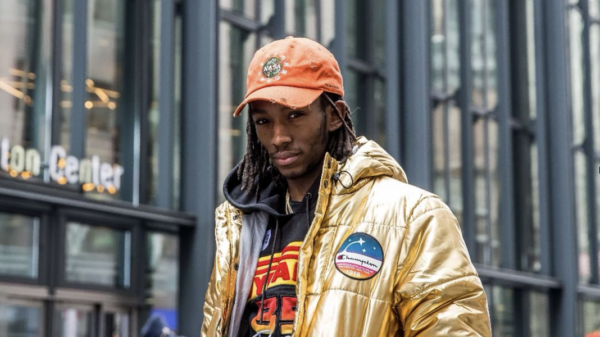



When Matthew Allen woke up on Saturday, Jan. 24, he was looking forward to running errands. Allen, better known in the Twin Cities as the musician and rapper Nur-D, had spent the previous day with thousands of Minnesotans marching on the streets in -15º weather to protest the ongoing violent federal occupation of the state. Now the weekend had arrived, and Allen woke up excited to spend his day shopping for window blinds and dog food with his wife. “I was planning on having a regular day,” he says.
But soon after getting up, Allen did what millions of Americans did that Saturday morning: He picked up his phone and found himself staring at footage of federal immigration officers shooting and killing VA nurse Alex Pretti in Minneapolis. Allen and his wife changed up their plans, thinking they’d stop by a protest for a little bit before going on with their day.
What happened, instead, is that Allen was chased, tackled, sprayed with an acrid substance, and violently detained by federal immigration officers, who, he claims, told him he was being arrested for assaulting a federal officer, a charge he says was baseless.
“My name is Matthew James Obadiah Allen,” he screamed while being pinned to the ground, “I have done nothing at all….I’m a United States citizen.”
Given what had happened earlier that day to Pretti, Allen says he believed, in that moment, that those would be his final words.
“I assumed I was going to die,” Allen tells Rolling Stone, “so I was going to make it as clear and concise as I possibly could.”
“You wanna kill me on the street?” he shouted as the masked men stood over him. “You’re gonna have to fucking kill me. I have done nothing wrong.”
Five days later, Allen thinks back to what was going through his head at that moment. “I’m not going to let you slave-catch me,” he says. “I’m not going to help you, in any way, make this into something it’s not. This is grabbing someone in the street who has done nothing wrong and killing them, and if that’s what we’re doing — I’ve already seen you do it today — that’s why any of us are even here right now. Most of us would rather be doing what we love to do on a Saturday morning.”
Editor’s picks
As Nur-D, Allen has made a name for himself in the Twin Cities scene, performing at the local Soundset hip-hop festival and collaborating with the Minnesota Orchestra in recent years. Much of his music, especially on his latest album, Chunkadelic, is about the joy he feels being from his hometown: “Turn to my neighbors, say where you from?” the Rosemount, Minnesota, native sings on “Franklin Ave,” before launching into the prideful chorus: “This my city, this my vibe, this my town.”
He is also a veteran of local community organizing and protest; the last time he spoke to Rolling Stone was May 2020, in the midst of the uprisings for George Floyd. “So much of what 2020 was, was ‘If this becomes something that is OK for the state to do, they will do it,’” Allen says today. “And the first people who are hit are the Black and brown people of our country.”
Speaking with Rolling Stone, Allen is ambivalent about the attention he’s received for his story of being violently detained last weekend. He understands that what happened to him pales in comparison to the violent disappearings and deaths of both American citizens and foreign-born people at the hands of the federal government across the country. Allen is not the first musician detained by immigration officials: Marcos Flores, the bassist in Denver-based band Summer of Peril, has been in a Colorado ICE detention facility for more than a month.
Related Content
“What happened to me probably won’t even be a footnote in what’s going on in our state and across the country,” says Allen. “But there are so many people who have been in the exact situation I was in, and they are just gone. So because I get to talk right now, I’m going to talk.”
Federal agents detained Nur-D at the Jan. 24 protest.
Richard Tsong-Taatarii/The Minnesota Star Tribune/Getty Images
After being arrested, Allen was placed in the back of a white pick-up truck (“worst-case scenario” as a Black man, he says) and then driven some distance to an unknown outdoor location in Minneapolis. At that point, Allen says, he was thrown out of the car, at which point he ignored a command to take his clothes off. “I refused to move my body,” he says. Instead, he kept repeating his full name, reiterating that he was a citizen, and asked to speak to a lawyer.
“I had asked, specifically, ‘If I comply with everything I am told to do, will I be shot?’ And the answer was silence,” he says. “So I didn’t move.”
After some time — he doesn’t know how long — Allen, who had been demanding medical attention after being sprayed with a chemical agent in the face, was placed in a stretcher, transferred to an ambulance, and brought to a hospital. It was not until he entered the emergency room at the Hennepin County Medical Center that he realized he might be safe. He is incredibly grateful for both the EMT professional named Andrew who calmed him down in the ambulance, as well as the nurses who provided care in the hospital. By evening, Allen was back at home with his wife.
Since then, Allen has been walking around with a knee brace and a limp. He’s banged up, and he’s had a hard time sleeping lately, knowing that ICE officials now have his name and could find him at any point. But above all, he feels lucky and fortunate. He’s since retained a team of attorneys, including Rodney King’s civil rights lawyer John Burris, to pursue legal action against the government for their violation of his civil liberties.
He’s grateful for his Twin Cities neighbors and doesn’t regret, for a second, having shown up to protest in the wake of Pretti’s death that Saturday morning. “The thing that pays my bills is that my community pays to see me do what I love the most,” he says. “How could I not be out here? It’s them — they’re the ones who spend five, seven, 10 dollars on my art. So if that’s something they’re gonna do, I will step up for them.”
What he wants those outside Minnesota to understand about the ongoing federal occupation (the government is referring to it as Operation Metro Surge, with a stated purpose of apprehending violent immigrants), is that the conflict between federal agents and the people of Minnesota has not been a fight between two equal sides.
“This is not the people you disagree with versus the people you agree with,” he says. “This is a heavily armed people willing to murder versus snowballs and signs….We’re human beings saying ‘Stop killing us.’ It’s crazy that that’s a political statement, and I would very much like it if people would stop making it one.”
Trending Stories
Speaking to Rolling Stone the day before a planned nationwide strike modeled after Minnesota’s recent statewide strike (and endorsed by everyone from Ariana Grande to Pedro Pascal), Allen can’t help but feel as though his home state has become a microcosm for the nation.
“Minnesota is like a mini-America,” he says. “We have a massively diverse group of people. We have a history both beautiful and horrific. And just like there are people in this country who say ‘We don’t want people different than us on our streets,’ there are thousands and thousands more who still stand in the street and say, ‘Those people are dumb.’ We love the differences that we all bring. We love our brothers and sisters and nonbinary people and two-spirit people, all the human beings that live amongst us. And we will not stop fighting.”


